Every January, billions of people do something remarkably ancient without realizing it. They pause at the threshold of a new year, glance backward at their failures and triumphs, then turn to face the blank calendar ahead with freshly minted promises. Lose weight. Read more. Call Mom. Be better.
What most don’t realize is that this ritualized this annual moment of dual vision ”was literally invented by a god. His name was Janus, and he had two faces for a good reason.
The month you’re living in right now bears his name. January. Ianuarius in Latin, derived from the word for doorway. And Janus wasn’t just any Roman deity. He was the god the Romans invoked before all others, the divine doorkeeper who stood at every threshold, every beginning, every ending. He was there when armies marched to war, when children were born, when the sun rose each morning.
He’s still here now, every time you write “January” on a check or whisper a resolution you hope this year will be different.
The God With No Greek Equivalent
Here’s something that would have made the Romans proud: Janus was theirs alone. While Jupiter mapped onto Zeus and Venus echoed Aphrodite, Janus had no Greek counterpart. He emerged from the oldest strata of Italic religion, a deity so fundamentally Roman that he represented something the Greeks apparently never thought to personify.
The threshold. The in-between. The moment of transition itself.
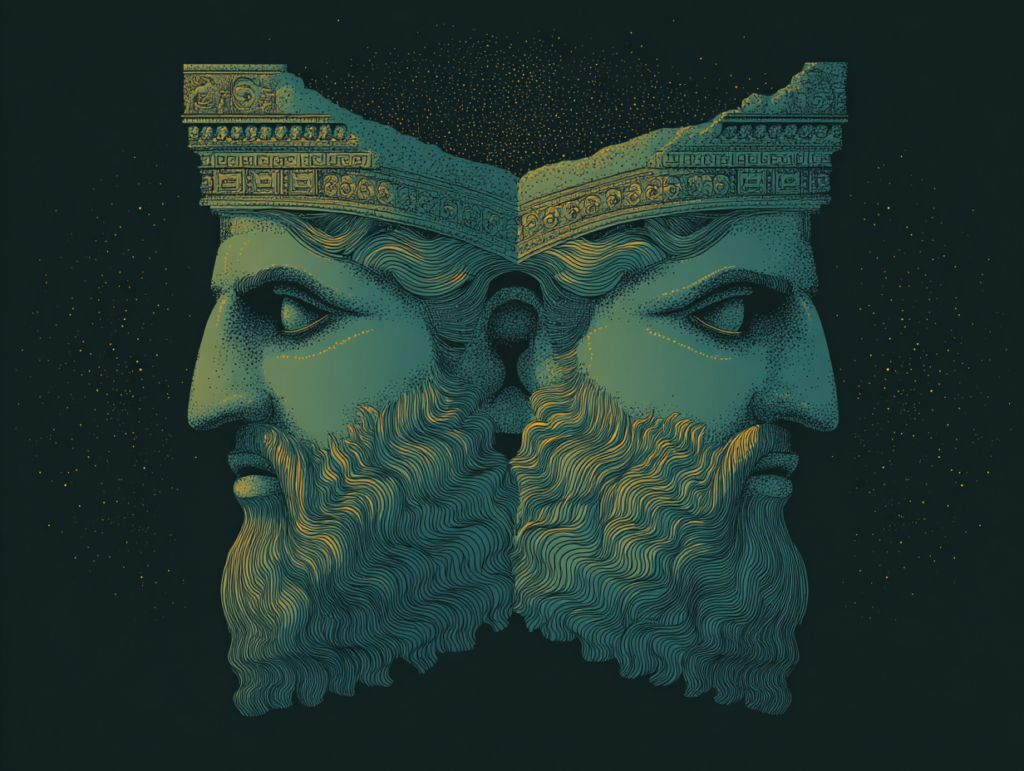
Ancient artists depicted Janus with two faces joined at a single head one bearded and mature, gazing into the past; the other sometimes younger, eyes fixed on what’s to come. Occasionally, he appeared with four faces, the spirit of crossroads and four-way arches, seeing in all directions at once.
In his right hand, he carried a key. As the god of doorways, he was the ultimate gatekeeper. Nothing began without his blessing. No ceremony commenced without invoking him first, regardless of which deity the ritual actually honored. The Roman scholar Varro explained it simply: Janus stood for the beginnings of action itself.
Before Jupiter. Before Mars. Before any of them, there was Janus.
Why January Belongs to the Doorkeeper
For most of Roman history, the new year didn’t begin in January at all. The original Roman calendar started in March, sacred to Mars, when spring thawed the ground and armies could march again. It was a practical choice for a warrior civilization: begin the year when you can begin fighting.
But around 713 BCE, the legendary King Numa Pompilius Rome’s second king and a man more interested in religion than warfare reformed the calendar. He added two new months to the beginning of the year: January and February. And he dedicated the first of these to Janus.
The choice was elegant. If Janus presided over all beginnings, shouldn’t he preside over the beginning of the year itself?
When Julius Caesar introduced the Julian calendar in 45 BCE, he formalized what had already become practice. Roman consuls had been taking office on January 1st since at least 153 BCE, and Caesar’s reforms made the Janus-blessed date the official start of the civil year throughout the empire.
The tradition stuck. Through the rise and fall of Rome, through the medieval period, through the Gregorian calendar reform of 1582, January 1st endured. We still begin our years at Janus’s door.
The Gates of War and Peace
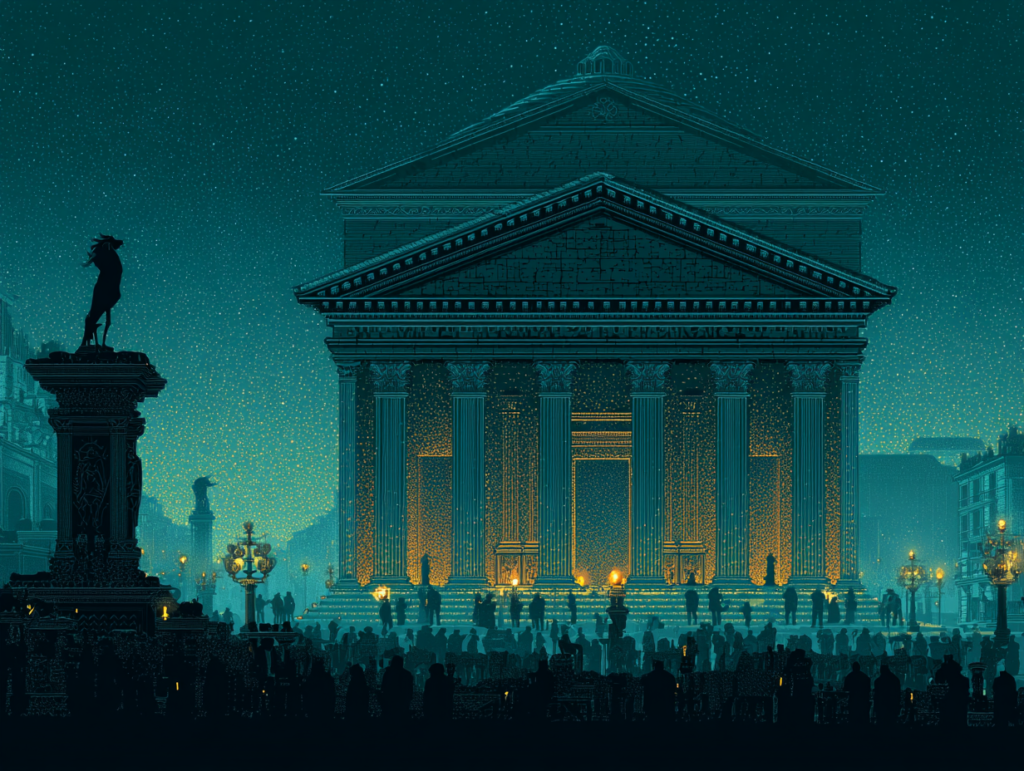
In the Roman Forum, near the Basilica Aemilia, stood one of the most symbolically loaded structures in the ancient world: the Temple of Janus Geminus. It wasn’t grand. Just a small bronze building with double doors at each end. But those doors carried the weight of an empire.
When Rome was at war, the doors stood open. When Rome was at peace, they were shut.
The meaning was debated even among Romans. Some said that open doors released Janus to accompany armies into battle. Others claimed the temple held Discord and Fury imprisoned during peacetime, the doors containing chaos itself. Still others argued the opposite, that Peace dwelt within, and opening the doors let her escape while war raged.
What wasn’t debated was the rarity of closure. According to the historian Livy, after King Numa’s peaceful reign, the gates remained open for over four hundred years. Continuous war. Endless expansion. The doors finally closed in 241 BCE after the First Punic War, only to swing open again for conflicts with the Gauls.
They didn’t close again until 29 BCE.
This was Augustus’s great boast. In his autobiography, the Res Gestae, he listed the closure of Janus’s gates among his greatest achievements, something he accomplished three times during his reign, more than all of Roman history combined. In 13 BCE, when he closed them to mark the Pax Romana, the empire stretched from Britain to Egypt, and no army marched anywhere.
For Romans, seeing those doors shut was like watching the impossible happen. Peace. Actual peace. The god of thresholds had finally stopped one particular transition: the passage from life to death in war.
Unravel the Threads of Myth with Saga
New Year's Day in Ancient Rome
January 1st in Rome would feel surprisingly familiar to us. There were festivals and parties. People exchanged gifts. Streets filled with music and celebration. Friends and neighbors greeted each other with wishes for a good year ahead.
The gifts themselves carried meaning. Romans presented each other with honey, dates, and dried figs, sweet foods meant to ensure a sweet year. Small copper coins called strenae represented hope for prosperity. Even the words people spoke mattered: on the Kalends of January, Romans believed that the words you used would echo through the coming months, so everyone made an effort to speak positively.
Sound familiar? “Happy New Year.” “Best wishes.” “Hope it’s a good one.”
We’re still doing what the Romans did two thousand years ago, still trying to launch the year with good omens, still believing or at least hoping that how we begin will shape what follows.
The poet Ovid captured the Roman mindset: offerings of sweet foods were omens for a sweet year. Start well to end well. Control the threshold, and you control what lies beyond it.
But Janus gave us something more profound than a date on a calendar. He gave us a way of thinking about time itself.
Consider his two faces. One looks back. One looks forward. The god exists permanently at the junction point between what was and what will be the eternal present of transition. He can’t ignore the past; one of his faces is fixed upon it. But he can’t avoid the future either; his other face stares directly into it.
This is exactly what we do every New Year’s Eve. We take stock. We remember. We regret. And then we turn our attention forward and make promises about what comes next.
The New Year’s resolution is Janus-thinking in action.
We’ve been doing it for millennia. Nearly four thousand years ago, the ancient Babylonians held a twelve-day festival called Akitu to mark their new year. During the festivities, they would crown a new king or reaffirm loyalty to their current one, plant crops for the coming season, and make promises to the god particularly pledges to repay debts and return borrowed items.
The Babylonians believed that keeping these promises earned divine favor for the year ahead. Breaking them invited divine displeasure. The mechanism was simple: accountability enforced by cosmic stakes.
The Romans adopted and adapted this practice, connecting it to their two-faced god. January 1st became the day of vows and intentions. Look back at what failed. Look forward to what could succeed. Make the promise at the threshold.
The Fresh Start Effect: Why Janus Was Right
Here’s where the ancient wisdom meets modern science.
In 2014, researchers at the Wharton School of Business published a study on what they called “The Fresh Start Effect.” Psychologists Hengchen Dai, Katherine Milkman, and Jason Riis analyzed data on gym attendance, Google searches for “diet,” and goal commitment platforms. They wanted to know: do people actually behave differently at temporal landmarks, moments that mark transitions in time?
The results were striking. Gym visits increased 47% at the start of a new semester. Diet searches spiked 82% at the start of a new year. Even the beginning of a new week showed measurable effects: people were 14% more likely to search for diet information on Monday than on other days.
The researchers’ explanation sounds almost mythological: temporal landmarks create psychological separation between our past and present selves. When you cross a threshold, a new year, a birthday, even a Monday morning you can mentally file away your past failures as belonging to a “previous you.” The fresh start isn’t just a calendar event. It’s a psychological reset.
“Those failures are the old you,” explained Milkman, “and this is the new you.”
Janus understood this four thousand years before psychology existed. The god of thresholds knew that transitions aren’t just spatial, they’re identity-shaping. When you pass through a doorway, you become someone who has passed through. You’re different on the other side, even if only slightly.
This is why the Romans invoked him at the start of everything. Not just years, but days. Not just ceremonies, but journeys. Every transition was a chance for transformation, and Janus stood at each one, watching you leave behind who you were and step into who you might become.
Of course, Janus’s gift comes with a catch.
Research by psychologist Richard Wiseman found that while 52% of people making New Year’s resolutions are confident they’ll succeed, only 12% actually follow through. The threshold is easy to cross; staying on the other side is hard.
The problem, psychologists say, is that we treat the fresh start as the work itself rather than the beginning of work. We expect the new year to transform us rather than recognizing it as simply the best possible moment to start transforming ourselves.
But here’s the thing: we keep doing it anyway. Every December 31st, millions of people who failed their last resolution make a new one. They look backward at their failures, forward at their hopes, and promise themselves that this time will be different.
This is the most Janus-like thing of all.
The two-faced god isn’t naive. He sees the past with perfect clarity all the broken promises, the abandoned gym memberships, the books left half-read. But he also sees the future, where things could go differently. He holds both truths simultaneously without letting either cancel the other out.
The cynic looks only backward and concludes nothing will ever change. The fool looks only forward and ignores the patterns that predict failure. But Janus and anyone who truly understands his wisdom looks both ways at once and finds meaning in the tension between them.
We make resolutions not because we believe we’ll definitely succeed, but because the alternative giving up on the possibility of change is unbearable. The threshold must be crossed. The past must not determine the future absolutely. There must always be a door.
The Wisdom of Two Faces
So here we are in January, Janus’s month, standing where countless generations have stood before us. The past is visible behind us everything we did and didn’t do, every promise kept and broken, every version of ourselves we used to be. The future stretches ahead, unknown but not formless, shaped by the choices we’ll make starting now.
What does Janus teach us about this moment?
First: honor the past without being imprisoned by it. One of Janus’s faces looks backward, but it doesn’t look longingly or regretfully. It simply sees. The past is information, not destiny. Last year’s failures don’t determine this year’s outcomes but ignoring them is foolish too.
Second: face the future with clear eyes. The forward-facing aspect of Janus isn’t dreamy or naive. It’s watchful. The future isn’t a fantasy where everything magically works out; it’s territory to be navigated with whatever wisdom the past has granted.
Third: understand that you are always at a threshold. The Romans didn’t just invoke Janus on January 1st—they invoked him at the start of every day, every ceremony, every journey. Every moment is a doorway. Every choice is a passage from one version of yourself to another.
This is perhaps why the Romans gave Janus precedence even over Jupiter, king of the gods. Jupiter might rule the heavens, but Janus ruled something more fundamental: the nature of change itself, the possibility of becoming something other than what you’ve been.
Your Threshold Moment
The next time you catch yourself at New Year’s or any fresh start, making promises about who you’ll become, remember that you’re participating in something ancient. You’re standing where the Babylonians stood four thousand years ago, where the Romans stood in the shadow of Janus’s temple, where every generation has stood in the presence of endings and beginnings.
The two-faced god doesn’t judge your resolutions. He doesn’t care if you succeed or fail. What he represents is simpler and more profound: the eternal truth that transitions are sacred, that thresholds matter, that the moment between what was and what will be is the only moment where change is possible.
You’re standing in that moment right now.
One face looking back. One face looking forward. Both yours.
What will you see?