On July 17th, Christopher Nolan’s The Odyssey arrives in IMAX with a $250 million budget, Matt Damon as Odysseus, and enough epic sweep to fill every 70mm frame. It will be breathtaking. It will also be the ten-thousandth time humanity has told this exact story.
Because here’s what the trailers won’t mention: the Odyssey isn’t Greek. Or rather — it didn’t start there, and it certainly didn’t end there. The story of a hero who leaves home, endures unimaginable trials, and fights his way back to where he belongs was already ancient when Homer first sang it. It had already been told in Mesopotamia, in India, in West Africa, across the Pacific. It has been told in every corner of the world by people who had never heard of each other.
That’s not a coincidence. It’s a window into what we are.
The Oldest Road Home
Let’s start at the beginning — the actual beginning. Roughly 1,000 years before Homer composed the Odyssey, a scribe in ancient Mesopotamia pressed reed into wet clay and recorded the oldest written epic in human history: The Epic of Gilgamesh.
Gilgamesh is king of Uruk, two-thirds god and one-third man, the greatest warrior of his age. His story begins not with wandering, but with friendship. Enkidu — wild man, creature of the steppe, made from clay and divine breath — arrives as Gilgamesh’s opposite and becomes his mirror. Together they slay the Bull of Heaven, defy the gods, and feel invincible. And then Enkidu dies.
It is that death that sends Gilgamesh on his road. Not duty. Not a war. Grief — and the terror of his own mortality. He walks to the ends of the earth in search of the one man the gods have granted eternal life: Utnapishtim, survivor of a great flood, keeper of the secret of immortality. He crosses the Waters of Death. He finds Utnapishtim. And the old man tells him, gently but without mercy, that what he’s searching for cannot be found.
Gilgamesh returns to Uruk empty-handed. He stands before his city walls and sees them, truly sees them — their strength, their beauty, the civilization he built — for the first time. The journey didn’t give him immortality. It gave him something harder to name.
Sound familiar?
Odysseus, Meet Your Predecessor
Homer’s hero leaves Ithaca for Troy and spends ten years trying to come home. He faces the Cyclops, the Sirens, Scylla and Charybdis, a descent into the underworld, a nymph who offers him immortality and whom he refuses. He wants, more than anything, to return to his wife, his son, his island.
The structural parallel with Gilgamesh is not accidental. Scholars have traced clear narrative borrowings — the flood story, the encounter with a divine figure who warns against seeking immortality, the tavern keeper (Siduri in Gilgamesh, comparable to Circe’s role as an island temptress who delays the hero’s return). The ancient world was more connected than we imagine. Mesopotamian stories traveled along trade routes into the Greek world centuries before Homer.
But here’s the more interesting question: why does the same structure appear in places that had absolutely no contact with the ancient Near East or the Aegean?
Rama’s Road: The Exile That Built an Empire
Half a world away from Ithaca, in the forests and kingdoms of ancient India, another story was taking shape. The Ramayana — composed somewhere between the 5th and 1st centuries BCE, though its oral roots are older — follows Rama, prince of Ayodhya, who should inherit his father’s throne but is instead exiled to the forest for fourteen years due to a palace intrigue.
Rama goes willingly. His wife Sita accompanies him. His brother Lakshmana refuses to let him go alone. And then, deep in the Dandaka forest, catastrophe: the demon king Ravana abducts Sita and carries her to the island of Lanka.
What follows is one of the most breathtaking quests in all literature. Rama forges an alliance with a kingdom of monkeys led by Hanuman — perhaps mythology’s greatest supporting character. They build a bridge across the sea. They wage war against Ravana’s fortress. Rama recovers Sita, defeats the demon king, and after fourteen years of exile, returns to Ayodhya to take his rightful place.
The parallels to the Odyssey are unmistakable: the hero’s absence, the faithful wife who waits (Sita and Penelope both resist pressure to remarry), the monsters and supernatural adversaries, the helpers encountered along the way, the triumphant homecoming. But the Ramayana didn’t borrow from Homer. It developed independently, from a different culture, a different religion, a different part of the earth. The two stories arrived at the same shape on their own.
The Exile Who Became a King: Sundiata of Mali
Move forward a thousand years and ten thousand miles west. In thirteenth-century West Africa, the griots — poet-historians of the Mande people — were preserving the epic of Sundiata, founder of the Mali Empire.
Sundiata’s story begins in humiliation. As a child, he cannot walk. His father’s other wives mock him and his mother openly. When his father dies, the court conspires against him, and Sundiata is driven into exile with his mother and siblings, moving from kingdom to kingdom, growing stronger in obscurity.
Meanwhile, back in Mande territory, a tyrant named Soumaoro Kanté ravages the people. The oppressed Mandinka send messengers to find the exiled prince. They need him to return. He gathers warriors, forges alliances, and returns to defeat Soumaoro in a legendary battle. Sundiata is crowned Mansa — king of kings — and builds an empire that will dominate West Africa for two centuries.
Exile. Trials. Return. Triumph. The structure holds, on a different continent, in a different language, among a people who had never heard of Odysseus or Rama.
Across the Pacific: The Voyagers Who Wrote the Sky
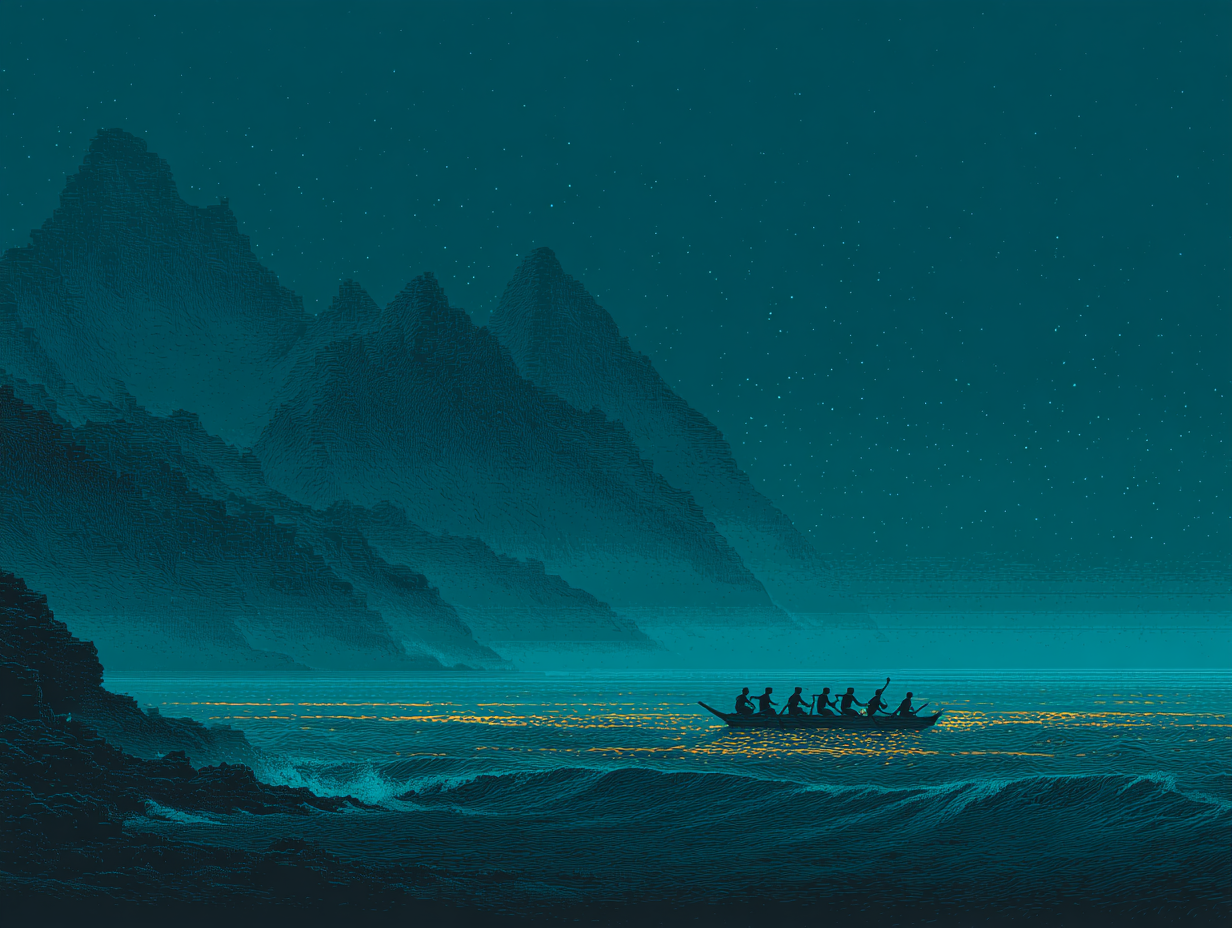
The Polynesian case is perhaps the most extraordinary. Between roughly 1000 BCE and 1200 CE, Polynesian navigators performed one of the most astonishing feats in human history: they settled the entire Pacific Ocean, from Tonga and Samoa to Hawai’i, Easter Island, and New Zealand — a triangle covering more than 70 million square miles of open water, navigated without instruments, guided only by stars, currents, swells, and birds.
This is not metaphor. These were real voyages. And they generated mythology to match.
Māui, the great trickster demigod whose legends span from Hawai’i to New Zealand, performs feats that encode these voyages in story: he fishes up islands from the sea floor with a magical hook made from his grandmother’s jawbone. He lassoes the sun with ropes made from his sister’s hair and slows its movement across the sky, giving humanity more daylight. He seeks the secret of immortality from the goddess of death, Hine-nui-te-pō — and fails, becoming the only Polynesian hero killed in the attempt.
The resonance with Gilgamesh’s failed search for immortality is striking. But more than any single parallel, what matters is the logic of these stories: a hero ventures into impossible distance, beyond the edges of the known world, and returns — or tries to return — changed. For the Polynesian tradition, the “road” was the ocean itself. Every voyage was an Odyssey.
Why Does Every Culture Tell This Story?
The question isn’t whether the Odyssey pattern recurs across cultures. It undeniably does. The question is why.
The psychologist Carl Jung would have pointed to the collective unconscious — the idea that certain deep structures of experience are shared by all humans and express themselves as universal archetypes in dreams, rituals, and stories. Joseph Campbell spent his career mapping what he called the monomyth: the hero’s journey, a narrative pattern he traced across hundreds of cultures and thousands of years. Departure. Initiation. Return.
But you don’t need Jung or Campbell to understand it. Think about your own life.
Every significant human experience involves leaving something behind — childhood, a relationship, a version of yourself — venturing into unfamiliar territory, facing difficulty, and returning different from how you left. The first time you moved away from home. A period of grief or illness. A job that broke you and rebuilt you. A journey that changed your understanding of who you are.
The nostos — the Greek word for homecoming that gives us nostalgia — is not just a narrative device. It’s a map of how humans transform. You cannot come back to the same place you left, because you are no longer the same person. Odysseus returns to Ithaca after twenty years, and even his dog barely recognizes him. He has to reclaim his home, his identity, himself. The return is never simply arrival. It is re-becoming.
That’s the story every culture keeps telling, because it’s the story every human keeps living.
What Nolan Understands
Christopher Nolan has always been a filmmaker obsessed with time, memory, and identity — with what happens to a person when the structure of reality they relied on collapses. Memento. Inception. Interstellar. Oppenheimer. Every one of his films is, at some level, about a man trying to find his way back to something he’s lost.
It’s not surprising that he was drawn to the Odyssey. What’s interesting is that he came to it the same way every storyteller in history has: not because it’s a Greek story, but because it’s the story. The one that says something true about what it means to be human and far from home.
Matt Damon’s Odysseus will sail across IMAX screens this summer. Audiences will watch the Cyclops and the Sirens with the full weight of a $250 million production behind them. And in doing so, they’ll be joining a tradition that stretches back five thousand years, across every ocean, to every civilization that ever looked at the horizon and wondered what lay beyond it — and what it would mean to come back.
Gilgamesh knew. Rama knew. Sundiata knew. The Polynesian navigators knew.
The Greeks just happened to write it down in the version that reached us.
Hear the Stories Yourself
The myths of Gilgamesh, Rama, Māui, and Sundiata didn’t survive because they were assigned reading. They survived because people told them — out loud, in the dark, to anyone who would listen. That’s exactly how Saga brings them back. Mythology as it was always meant to be experienced: as a voice in your ear, a story in the night.
Explore the great myths of the world on Saga — the first audiobook app entirely dedicated to mythology.